
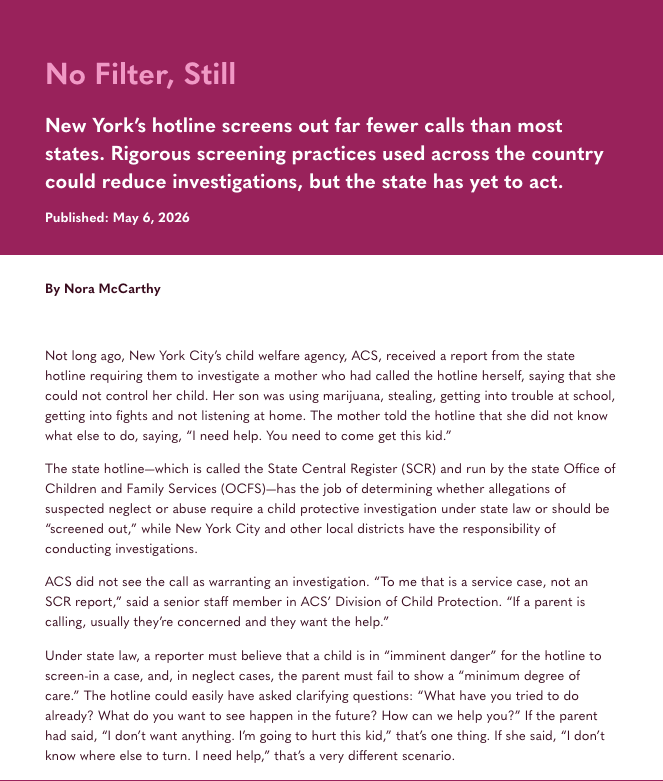
FPP’s new report, No Filter, Still, examines the slow pace of change to New York’s child abuse and neglect hotline — the State Central Register (SCR), run by the Office of Children and Family Services (OCFS).
The Problem: Poor Screening Unnecessarily Entangles Families in the Child Welfare System
The SCR determines whether allegations of suspected neglect or abuse require a child protective investigation or should be “screened out.” While states increasingly use rigorous and data-driven tools to guide staff through complex screening determinations, in New York:
- OCFS provides no standardized decision-making tools and offers little real-time support to staff to guide decision-making.
- Staff do not have the training and tools to make consistently accurate, lawful determinations.
The result is that:
- New York’s SCR screens out only about 25% of calls annually, half the national average of 50%.
- This contributes to an investigation rate that was 17% higher than the national average in 2024.
- Upstate counties are hit the hardest, with investigation rates 37% higher than in the city.
- This burden is borne largely by Black and Latino families: 53% of Black children and 42% of Latino children can expect an investigation by age 18, even though almost 80% of cases are not substantiated.
The Solution: Data-Driven Approaches Could Reduce Investigations by 50,000 Cases Annually
New York can:
- Implement a rigorous, data-driven screening tool that has been shown to improve the consistency and accuracy of screening decisions.
- Allow local districts to do an additional review of certain cases to eliminate malicious or unwarranted investigations.
- Reinvest reductions in investigative costs into approaches that support family safety and well-being.
Reforms that bring New York’s screen-out rate in line with the national average could reduce investigations by approximately 50,000 cases annually.
Staff Need Rigorous Tools and Support to Screen Accurately
New York’s hotline staff work under significant pressure, with few formal opportunities for review and support.
- The SCR expects its staff to make an immediate decision while still on the phone with the reporter.
- Supervisors are expected to review only one call per staff member each month.
- Only 40% of SCR staff have previous CPS experience, compared to 80% or more in some other states.
By contrast, states typically use more structured approaches to help screeners make determinations. These tools:
- Offer a series of prompts and decision trees to ensure that all screeners seek to uncover similar information.
- Help hotline staff apply critical thinking skills and use a rigorous decision-making process.
- Are tested to ensure that screeners make consistent, accurate decisions.
Senseless Cases Stress Families
“An investigation is rarely a neutral activity,” said Phil Decter, director of the Quality Improvement Center on Helplines and Hotlines.
- Research has documented that investigations alone leave lasting negative imprints.
As one mother testified in 2024, her family was investigated because their older child’s preschool alleged that she attended school in dirty clothing. Meanwhile, her newborn was in the NICU with a life-threatening lung infection.
- “This was a waste of resources that caused pain and suffering in our loving home,” she testified. “This report should never have been accepted.”
Child Welfare Agency Leaders Agree That Change Is Needed
It’s not infrequent that investigators learn new information in the first conversation with a reporter that could have led the case to be screened out.
- “From a CPS standpoint, those cases bog the system down,” said one ACS leader.
- “There are opportunity costs when there is an influx of SCR reports that could have been ruled out with simple, streamlined questioning,” said an upstate county commissioner.
Several report types rarely result in a safety intervention:
- 2,500 NYC calls were parent self-reports, with only 9% substantiated in 2023, compared to 22.5% of all cases that year.
- 8,000 calls by education reporters alleged neglect-only, with just 11% percent substantiated.
- Almost 3,400 reports alleged only educational neglect, with just 8.5% substantiated.
Good Screening Can Improve Safety and Save Money
Child protection cases cost the state an estimated $400 million annually in personnel costs alone—$142 million of that in NYC—paid out largely by New York taxpayers.
- If the SCR screened out only 10,000 more calls—or 5% more—that would net a reduction of about 20,000 CPS cases.
- At an estimated cost of approximately $2,200-2,800 per case in both the city and state, declines in investigations can reduce costs by tens of millions.
- These cost reductions can be reinvested to strengthen family supports, improving child safety.
Waiting Five Years for Change Is Too Long
OCFS does not plan to take a first step toward designing a tool—a multi-year process—for at least another 18 months. At this pace, screening decisions cannot be expected to change for nearly five more years.
It may require legislation and significant pressure from state leaders, county commissioners and advocates to compel OCFS to accelerate its timeline and catapult New York’s hotline from lagging to leading.
>> Learn How Cost Reductions from Hotline Reform Can Be Reinvested Upstream