
By Nora McCarthy
Not long ago, New York City’s child welfare agency, ACS, received a report from the state hotline requiring them to investigate a mother who had called the hotline herself, saying that she could not control her child. Her son was using marijuana, stealing, getting into trouble at school, getting into fights and not listening at home. The mother told the hotline that she did not know what else to do, saying, “I need help. You need to come get this kid.”
The state hotline—which is called the State Central Register (SCR) and run by the state Office of Children and Family Services (OCFS)—has the job of determining whether allegations of suspected neglect or abuse require a child protective investigation under state law or should be “screened out,” while New York City and other local districts are responsible for conducting investigations.
ACS did not see the call as warranting an investigation. “To me that is a service case, not an SCR report,” said a senior staff member in ACS’ Division of Child Protection. “If a parent is calling, usually they’re concerned and they want the help.”
Under state law, a reporter must believe that a child is in “imminent danger” for the hotline to screen-in a case, and, in neglect cases, the parent must fail to show a “minimum degree of care.” The hotline could easily have asked clarifying questions: “What have you tried to do already? What do you want to see happen in the future? How can we help you?” If the parent had said, “I don’t want anything. I’m going to hurt this kid,” that’s one thing. If she said, “I don’t know where else to turn. I need help,” that’s a very different scenario.
But at New York’s hotline, these kinds of probing questions are rarely asked. Instead, hotline operators are trained to ask minimal questions and to make quick decisions.
New York screens out only about 25 percent of calls annually—half the national average of 50 percent. While the state hotline receives calls at a rate slightly lower than the national average, the low screen-out rate contributes to an investigation rate that was 17 percent higher than the national average in 2024. Upstate counties are hit the hardest, with investigation rates 37 percent higher than in the city.
CPS Investigation Rates per 1,000 Children by County, 2022
 Statewide, 1 in 21 children were subject to a CPS investigation in 2022, with some counties reaching nearly double that rate. This map shows how rates vary across counties and New York City.
In March 2024, NYC Family Policy Project (FPP) released a report, No Filter, documenting for the first time that New York’s hotline has one of the lowest screen-out rates in the country. When the state Assembly held a hearing that October, little was known about why.
Today, the problem is clear: While states increasingly use rigorous and data-driven tools to guide staff through complex screening determinations, OCFS provides no standardized decision-making tools and offers little real-time support to staff to guide decision-making. The result is that, although New York’s statutes offer significant latitude to apply scrutiny and judgment to screening decisions, staff do not have the training and tools to make consistently accurate, lawful determinations.
The solutions also are clear. At a cost of approximately $2 million, the SCR can work with experienced consultants to implement a comprehensive screening tool that is consistent with national best practices. Through legislation, the state also can activate local districts to do an additional review of certain cases to eliminate malicious or unwarranted investigations.
Remaking the hotline can be expected to substantially reduce investigations while also freeing up millions that could be reinvested to strengthen family supports, improving child safety. The case of the New York City mother struggling with her son is illustrative. NYC has in-home programs to address the family’s exact challenges and the hotline could have transferred her call to the state family support warmline or ACS’ Preventive Support Line so she could directly enroll. Instead, the SCR accepted the call as a neglect report, subjecting the mother to an investigation.
OCFS officials have acknowledged that concerns driving investigations can often be resolved without a child protective response, and that frightening and often traumatic investigations leave lasting harm. The agency was at the forefront nationally in 2023 when it rolled out a new mandated reporter training to stem unnecessary calls along with its HEARS warmline for family supports, calling these efforts “necessary to put an end to the practice of punishing race and poverty.”
Yet under Commissioner DaMia Harris-Madden, the agency has been slow to act. More than 18 months after the Assembly hearing, OCFS is only in the “very baby stages” of making a plan, senior leadership acknowledges. The commissioner has “made it very clear that the direction we want to go in as an agency is to include a standard decision-making tool,” said Executive Deputy Commissioner Laura Darman. However, the agency does not plan to take a first step toward designing a tool—a multi-year process—for at least another 18 months. At this pace, screening decisions cannot be expected to change for nearly five more years.
This burden is borne largely by Black and Latino families. Statewide, an estimated 35 percent of all children can expect an investigation by age 18, including 53 percent of Black children and 42 percent of Latino children, even though almost 80 percent are not substantiated.
The lack of a screening tool is also costly. Child protection cases cost the state an estimated $400 million annually in personnel costs alone—$142 million of that in NYC—paid out largely by New York taxpayers. Even a 10 percent decrease in unnecessary investigations could save tens of millions of dollars annually that can be reinvested to reach families upstream.
This report:
- Provides new information and data about the screening processes used in New York state’s SCR—and the impacts of using an outdated approach;
- Compares New York’s practice to the rigorous and reliable screening tools used in other states;
- Recommends a set of upgrades that will bring New York in line with data-driven practices;
- Outlines a holistic hotline reform and a reinvestment approach that can work in concert to better serve New York families.
Nationwide, hotline practices are largely hidden, with little public information on screening tools or reform efforts. In addition to available research and information, this report relies on in-depth interviews with hotline leaders in four states conducted on background, as well as interviews and discussions with experts at Child Trends, Action Research and the National Resource Center for Helplines and Hotlines; child welfare agency leaders, attorneys and advocates in New York; and families impacted by investigations, including those who testified at the Assembly hearing. It is also informed by a visit to the SCR and multiple interviews and conversations with OCFS staff over the past 8 months.
How New York's Screening Compares Nationally
Compared to the national average, New York receives fewer calls but investigates more children.
While New York receives calls at a rate slightly lower than the national average, the state screens out only about 25 percent of calls annually—half the national average of 50 percent. This contributes to an investigation rate that was 17 percent higher than the national average in 2024.

The Problem and Potential of New York’s Hotline
Well before New York’s low screen-out rate came to the public’s attention, OCFS was aware of both the problem and potential that the hotline posed. “Our agency continues to take a critical lens to when calls to the SCR are accepted and what types of reports are being made as a critical step in understanding how to continue our reform efforts,” former Acting OCFS Commissioner Suzanne Miles-Gustave testified at a 2022 Assembly hearing on mandated reporting.
For a number of years, OCFS has been part of a learning group with leaders of other state hotlines. Some started out with hotlines that, like New York’s, operated more like a dispatch or call center than a screening division that makes safety decisions at child welfare’s front door. In this type of operating structure, hotline staff ask basic questions to determine whether the reported concern can be matched to a state definition of maltreatment but leave more assertive probing to investigators. “We’re not trying to screen in and out,” SCR Director Brian Kelley said. “I’m not a big fan of those terms.”
By contrast, states typically use more structured approaches to help screeners draw out more information about a reporter’s concern and apply critical thinking skills and teamwork to complex decisions. These tools offer a series of prompts and decision trees to ensure that all screeners seek to uncover similar information and move through a rigorous decision-making process to make consistent, accurate decisions.
Some states also include a secondary screen that functions like a mini-investigation. That can involve reading case records, talking more in depth to the reporter, or even speaking with another professional in the family’s life or with the parent before making a decision about whether to open a full investigation.
In some jurisdictions, hotline reforms that prompt careful examination of reports are becoming the linchpin of efforts to develop stronger community responses to support families in distress. Whereas hotlines have typically acted as a fork in the road, accepting some calls and rejecting others, these hotlines are coming to function like a traffic circle, dismissing many reports, redirecting others to community support options, and ensuring that calls only go down the child protective pathway when children may be in real danger.
‘An Investigation Is Rarely a Neutral Activity’
New York’s high-acceptance, low-bar screening is not unusual but it has come to be seen as outdated as child welfare investigations have become more pervasive. The proportion of U.S. children subject to a child welfare investigation increased 30 percent between 1996 and 2018, while new research has documented that investigations alone leave lasting negative imprints. Fearful of another contact with a system that has the power to remove children, parents confide less in friends and family and conceal the depth of their needs when seeking help, increasing family precarity.
“There was a time where people thought the high stakes was only a false negative—you missed it and a child got hurt,” said Phil Decter, director of a new Quality Improvement Center on Helplines and Hotlines, which the federal Children’s Bureau established in 2024. “Hotline workers and agencies are much more aware now of the dangers of false positives and subjecting a family to an unnecessary investigation. And the field is more cognizant that an investigation is rarely a neutral activity.”
New York’s screening style is not the only reason for its low screen-outs. While screeners in other districts typically make a screening determination after hanging up the phone and have the opportunity to consult with a team or supervisor, the SCR expects its staff to make an immediate decision while still on the phone with the reporter.
New York’s hotline also provides little formal oversight after the initial training period. Supervisors are expected to review only one call per staff member each month unless a staff member is on probation. The quality assurance team is deployed to special projects and complaints, not ongoing monitoring.
The effect is that staff work under significant pressure, with few formal opportunities for review and support.
New York’s SCR staff also are less likely than screening staff in some states to have a background in child protective investigations. Former CPS have experience probing reporters and understand what it means to screen-in a case. They also know how infrequently reports reflect immediate danger. In NYC, for instance, 93 percent of reports investigated by CPS are not deemed serious enough to warrant any further intervention.
A number of states prioritize or even require hiring former CPS investigators, with former CPS making up 80 percent or more of hotline staff in some locales. To recruit former investigators, many states allow screening staff to work from home after training, enabling hires from across the state. Currently, only 40 percent of New York’s hotline staff have previous CPS experience, according to OCFS. Although they already work at home half the time, staff are drawn only from the Albany region.
Working at the hotline is a difficult job. Staff absorb painful stories, frightening images, fearful callers. Some have listened as children are hurt. Faced with vague statutory language, minimal guidance, and lack of personal experience conducting investigations, it’s understandable that, in complex cases, they might defer to local CPS rather than make a difficult judgment call.
Senseless Cases That Stress Families
That caution, however, has significant negative downstream repercussions. When investigators receive a report from the SCR, one of their first steps is to talk to the reporter. It’s not infrequent that investigators learn new information in that first conversation that could have led the case to be screened out, according to leadership at ACS and some upstate counties.
Some cases appear bizarrely out of sync with state statutes. Not long ago, ACS received a report that a teenager’s grandmother had passed away. The child’s uncle had called the SCR for help and it was screened in—requiring an investigation of the uncle. In Essex County, hospitals repeatedly call in neglect allegations when they want to discharge children with mental health crises and the parents refuse to bring them home because of safety concerns but are actively working with state agencies to find a stable care option, said Angie Allen, commissioner of the Essex County Department of Social Services. In the midst of managing their child’s mental health crisis, the parents have to handle an accusation of neglect.
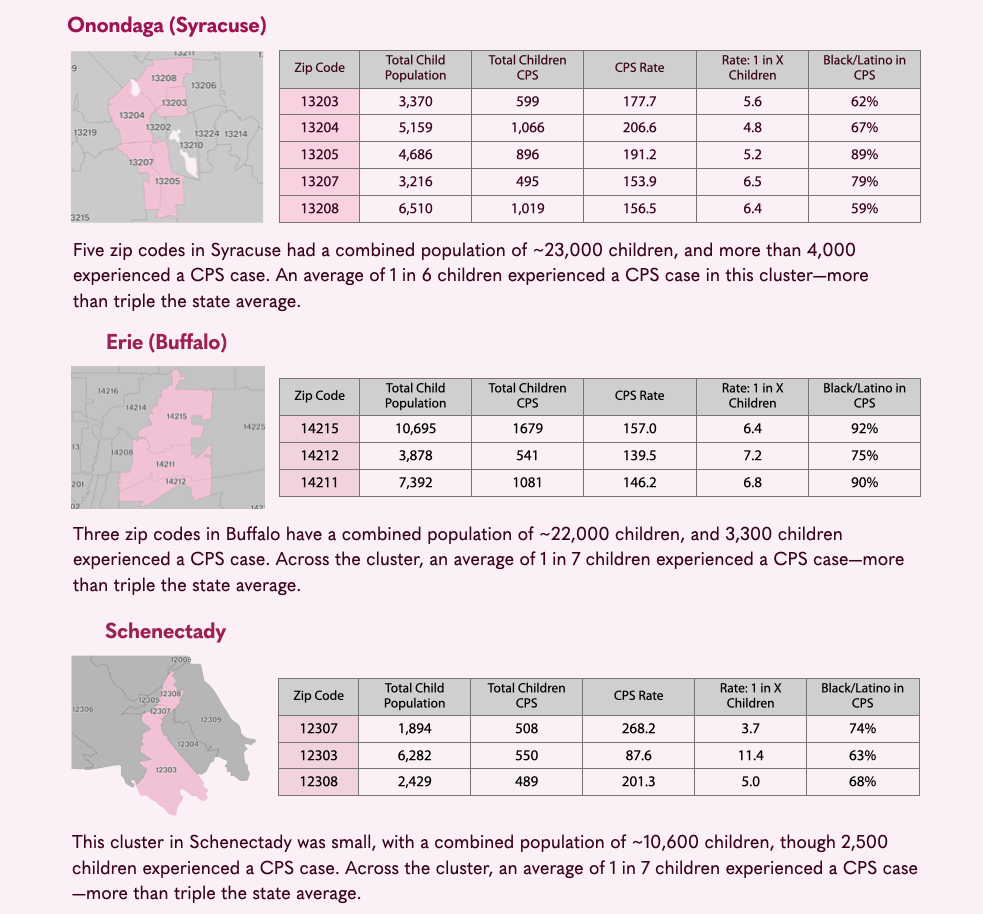
Spotlight: Zip Codes Highly Impacted by Investigations
In 2024, the average rate of CPS cases across New York state was 47.4 per 1,000 children. This means that 1 in 21 children experienced a CPS case. While NYC has often been the focus of advocacy efforts to address the harmful effects of investigations, many counties upstate have much higher investigation rates. Upstate data below reflects 2022 OCFS data obtained by a FOIL request and 2023 ACS data.

The hotline also has screened in calls about domestic violence incidents that happened months before, which parents recounted in the process of getting help leaving their abuser, although the child was no longer in the home with the perpetrator. And, surprisingly, it’s not rare for the hotline to screen-in reports about children’s deaths that happened months before—some that ACS already investigated—that parents then described to a therapist who they had seen for grief counseling. In many cases, local districts have appealed these types of screens-in to the SCR but been refused.
Parents: ‘We Live in Fear’
Even when children are quickly assessed not to be in imminent danger, child protective cases cannot simply be closed. Regulations in New York state require that each case includes multiple visits to the home, interviews with people who know the family, record gathering and extensive documentation. The typical case lasts 40-60 days.
In interviews with 40 parents in 2021, parent researchers at Rise, an advocacy organization, found that parents experienced common investigative practices as deeply violating. “They want you to drug test because somebody—your neighbor—somebody is mad at you,” said one focus group participant, who believed the report against her had been made maliciously. Another described her discomfort watching a male investigator speak with and examine her daughter, saying, “I was uncomfortable with that, and they really violated that value.”
Even when parents spoke of getting support with access to helpful services like childcare, parenting classes, or help with a child’s diagnosis, the fear and the pain of judgment lasted. “So much loss comes from having an ACS case,” one of the parent researchers testified to the Assembly in 2021. “We live in fear that we’ll be punished and judged for not complying with the system’s unattainable demands.”
At the 2024 Assembly hearing on the SCR, a mother testified that her family was investigated while their newborn was in the NICU for 40 days with a life-threatening lung infection. Their older child’s preschool alleged that she attended school in dirty clothing. For two months, they needed to juggle the ACS case along with their children’s care.
“We urge you to hear in our experience that this was a waste of resources that caused pain and suffering in our loving home,” this mother wrote in anonymous testimony. “If there had been a discerning assessment through which the SCR could have gotten some answers to basic questions about the case, it would have become clear that this report should never have been accepted.”
Spotlight: Zip Codes Highly Impacted by Investigations
‘These Cases Bog the System Down’
NYC data suggests that some types of reports could be more aggressively screened-out. In 2023, screened-in calls in NYC included approximately 8,000 calls by education reporters that alleged neglect-only, with just 11 percent substantiated, and almost 3,400 reports that alleged only educational neglect, with just 8.5 percent substantiated, compared to 22.5 percent of all cases that year.
Educational neglect cases that reflect truancy, not parental neglect, are particularly frustrating in many districts. One typical recent NYC case was a screened-in call from an educator reporting truancy who told the hotline that the mom was aware of her son’s behaviors and had cooperated with the school but was unable to control him. Again, neglect requires that a parent is not minimally caring for their child. In this case, as one ACS leader put it, “Unable is not unwilling.”
Almost 20,000 reports in NYC in 2023 alleged only “inadequate guardianship,” an allegation so broadly defined that it was included in 85 percent of all reports referred to ACS in 2023. In practice, inadequate guardianship functions as a catch-all for reports that don’t closely match more specific abuse or neglect definitions. More than 2,500 calls that were sent to the city for investigation also were self-reports by parents, of which only 9 percent were substantiated.
“From a CPS standpoint, those cases bog the system down,” said the ACS leader. “You’re taking time away from working with families that really need our support.”
Upstate, where investigative caseloads are often twice as high as in the city, unnecessary cases have even more serious effects. With only about half a dozen CPS responding to more than 400 cases each year—and staff trading being “on call” on nights and weekends—every case is felt. Allen, the commissioner in Essex County, sees unwarranted cases as contributing to burnout and retention issues. “There are opportunity costs when there is an influx of SCR reports that could have been ruled out with simple, streamlined questioning,” she said.
About 41 percent of New York’s $400 million annual protective services spending is covered by local taxes and 46 percent are covered by state taxes, with the remainder federally funded. This means that the city and state could redirect over-spending on investigations to better support families.
If the state screened out 50 percent of calls, in line with the national average, that would reduce CPS cases by approximately 50,000 annually. More conservatively, even if the SCR screened out only 10,000 more calls—or 5 percent more—that would net a reduction of approximately 20,000 CPS cases. At an estimated cost of approximately $2,200-2,800 per case in both the city and state, declines in investigations can reduce costs by tens of millions.
New York Screened-in and Screened-out Reports, 2018 - 2024


The percent of reports screened out has risen 2.5% since 2018 while the total number of reports has fallen by 8%, leading to a 12% reduction in screened-in reports. New York is one of only six states that reports no “screened-out” calls to the federal data system. Data provided by OCFS shows that the state screens out approximately 50,000 calls annually. OCFS will begin reporting federal data for FY 2026.
Reforming a ‘Risk-Averse’ System
Many states that have developed structured screening tools have significantly increased screen-outs while reducing investigations.
A study of Indiana, for instance, found that the state had a high screen-in rate and one of the highest investigation rates in the nation, investigating nearly 1 in 10 children annually. (Currently, New York investigates 1 in 21 children each year.) Examining screened-in reports from 2016-18, researchers concluded that half were “false positives”—they were not substantiated and were not followed by later substantiated reports, either. The study authors concluded that Indiana had been operating a “risk-averse” screening system and noted concerns that “agency resources may be inappropriately directed towards investigation.”
Indiana worked with the nonprofit Evident Change to develop a screening tool and, between 2016 and 2024, its rate of screened-in calls fell, reducing investigations by 16 percent. Oregon and Connecticut among other states also have shown reductions in investigations after instituting a Structured Decision-Making tool.
To develop detailed guidance and question sets, jurisdictions look carefully at state statutes, which can be very broad, leaving wide latitude for interpretation. Multidisciplinary teams that include hotline staff, investigators, community partners, specialists like doctors or domestic violence experts as well as impacted parents and youth contribute to decisions about how the hotline interprets and applies state law.
Read the Case Studies
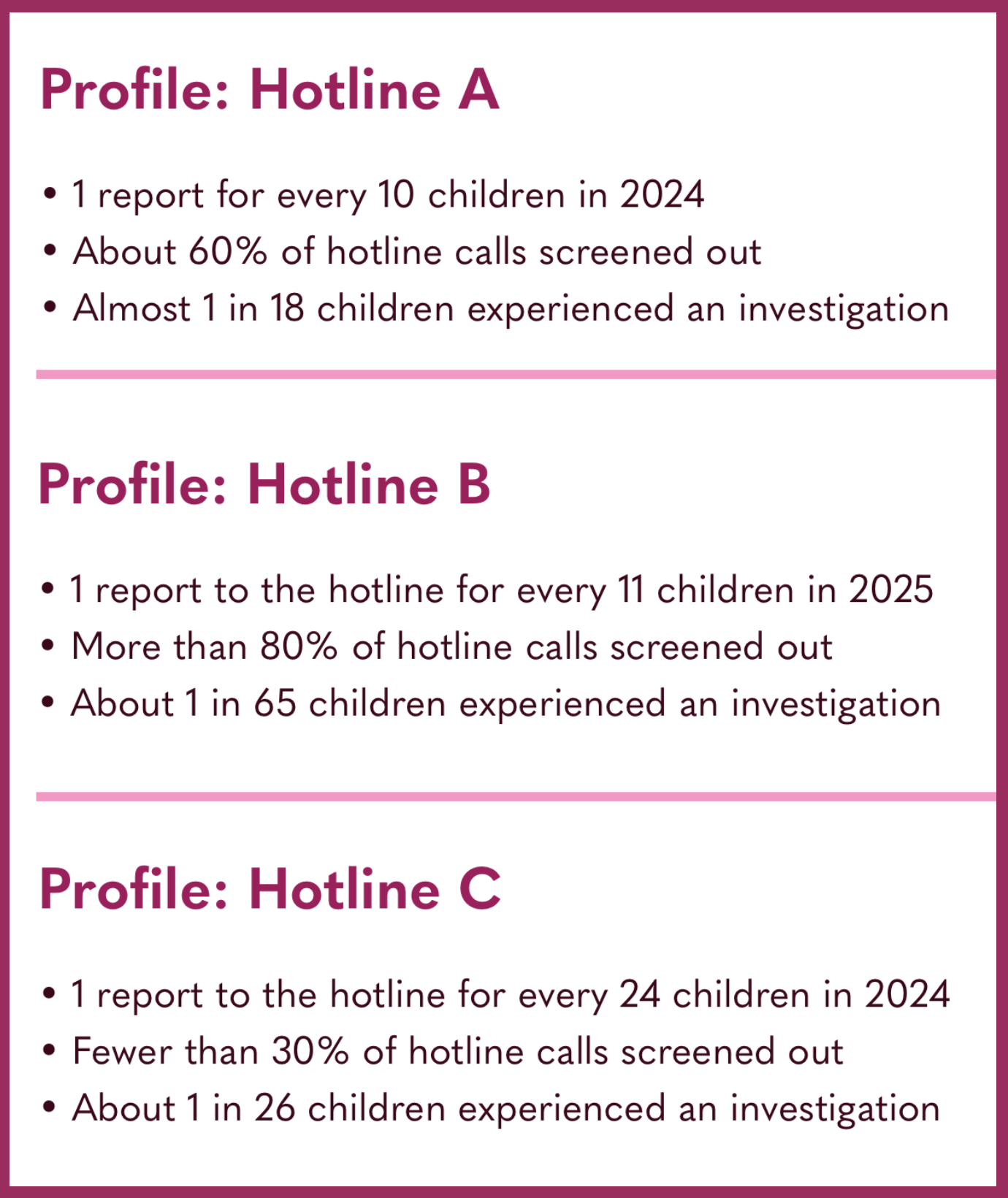
To examine how New York could bring its hotline in line with rigorous, data-driven approaches used in other states, FPP spoke to experts and interviewed hotline leaders in-depth. FPP profiled three states to explain the process of developing a screening tool and undertaking broader hotline improvements.
From ‘What If’ to ‘What Is’
Rigorous screening tools include clear definitions of abuse and neglect in plain language paired with questions to probe the severity of the concern and the impact on the child.
California’s screening tool, for instance, includes strongly worded guidance on inadequate clothing and hygiene. Caregivers must “willfully or negligently fail” to meet a child’s needs “to the extent that the child’s daily activities are negatively impacted and/or the child develops or suffers a worsening medical condition.” It gives examples including “sores, infection, or severe diaper rash; inability to attend school due to persistent or recurring lack of clean clothing; and/or experiencing shame or isolation from peers due to poor hygiene/extreme body odor.”
It also warns that “a child must be at substantial risk of suffering serious physical harm or illness to fall within the definition of general neglect.”
Similarly, Oregon’s tool states: “Reports of ‘no food’ need to be thoroughly assessed for availability, frequency, duration, other contributing factors, or other means of sustenance (e.g., eating at school, with family) before deciding that lack of food is creating or likely to soon create a significant threat to child safety.” Suggested questions for screeners to ask include:
- Is there a barrier to the adult’s meeting this need? Are there any supports in place that help meet this need? If those aren’t working, why?
- Has the parent reached out for help with this child’s need?
- Can you tell me about a time when the child has had this need met?
Training focuses on interview skills and critical thinking. “This is a social work tool,” emphasized one hotline director. “We’re doing an assessment of each call with the recognition that we need to keep kids safe and also with the recognition that, a lot of times, they’re unsubstantiated allegations. And what good comes from those? How is that benefiting the family?”
In this jurisdiction, the hotline did a lot of work with staff to ensure that screened-in reports reflected immediate danger or substantial risk of harm. As the hotline director explained it, “We really try to get people away from the ‘what if’ to the ‘what is.”
‘Small Changes Can Make a Big Difference’
In New York, a similar process could require SCR staff to apply scrutiny and judgment to whether the allegations meet state definitions of neglect or abuse. This process could start with training staff to probe the statutory grounds already written into law for screening out reports. These are: “no reasonable cause to suspect” abuse or neglect, “no harm/effect on child” and “no imminent danger” of harm, as well as evidence of a parent’s “minimum degree of care.” (See Terms & Definitions for legal definitions of abuse and neglect in New York).
From 2018-2024, only 12 percent of calls—or about 25,000 calls out of approximately 200,000—were not accepted by the hotline for investigation for these reasons.
New York Screened-out Reports by “Closure Code,” 2018 - 2024

When rejecting a call, SCR staff select a single “closure code” that best describes which required element for accepting a call was not met. However, there is no closure close for "minimum degree of care," even though that is a required consideration for an allegation of neglect under state law.
In NYC, child protective investigators commonly ask questions in their first conversation with a reporter that could be asked at the hotline to examine whether a caller has “reasonable cause to suspect.” Such as:
- What made you make this call today? What’s your motivation for the call?
- Did you see or hear this yourself? Are you getting it from someone else?
- How long have you known this family? Can you tell me a little more about the children?
- Do you think this incident was purposeful or do you think it was a mistake?
- Do you think this is happening all the time or happened one time?
- Do you have physical evidence like pictures, text messages, social media posts?
Even without legislative change, OCFS could examine “inadequate guardianship” to clarify what meets this neglect standard and narrow down its current wide application. The agency also can make modest, immediate changes in hotline practice, such as to allow staff to hang up the phone before making a decision; increase quality assurance oversight; and give greater consideration to screen-ins that local districts flag for re-review.
“Small changes can make a big difference,” said Decter. “If the supervision was a little more present, if there were small improvements in critical thinking, if workers were skilled in asking a few more questions—all of these things would contribute to improved decision-making.”
From Lagging to Leading
It’s clear how OCFS can upgrade New York’s hotline to use rigorous tools that have been shown to improve the consistency and accuracy of screening decisions. The state can begin by bringing a consultant to assess SCR practices and help develop a blueprint and budget for implementation.
Legislation can add a secondary screen at the local level to flag concerning reports. New York state law does not allow hotline staff to review case records or to disbelieve a reporter. New legislation could allow investigators with local knowledge to scrutinize certain potentially malicious or unwarranted screened-in reports, reviewing the case record and speaking to the reporter in more detail before determining whether to conduct a full investigation.
As part of a package of SCR reform bills, the legislature also could help accelerate other critical efforts to support families more holistically. Hardships including food shortages, difficulty paying rent, utility shutoffs, unstable housing and inability to access medical care strongly predict neglect reports. These common issues can often be resolved if a parent receives the right referral, but few communities have warmlines or community groups with the capacity to provide immediate coordinated, safe and accessible pathways to support.
With reforms to New York’s SCR screening process expected to lead to significant and sustained reductions in investigations, it is possible to create a state reinvestment structure that would channel savings into community approaches that support family safety and well-being.
In some locales, one priority might be to invest in keeping investigative caseloads low. Lower CPS caseloads often reduce deeper family involvement in child welfare interventions, like court supervision and foster care. More broadly, advocates have developed two concrete proposals that would make it easier for families to access support, particularly through trusted, grassroots groups—a state Child and Family Wellbeing Fund and a new city Office of Family Well-Being.
A reinvestment structure tethered to SCR reforms can produce a virtuous cycle: reducing painful and costly crisis intervention could net new savings and further investments that strengthen family well-being.

Read Reinvesting Upstream
New opportunities for New York to shift child welfare spending can enable new investments in families and further reduce traumatic and costly crisis intervention.
‘Baby Stages’
In some respects, New York is ahead of other states in creating a holistic approach to responding to family distress. In 2023, OCFS was a national leader in rolling out its mandated reporter training. The agency also has increased investments in home visiting and family resource centers, and the HEARS warmline now takes 4,000 calls annually for assistance ranging from baby items to housing assistance. (Only 400 of those calls were referred by the SCR last year, however, even though it received approximately 200,000 reports.)
In interviews, OCFS staff who directly run the hotline also indicated pride in recent efforts to strengthen screening of certain types of calls. The SCR added more questions about education neglect in response to a 2019 law limiting acceptance of educational neglect reports and to COVID-era guidance on school attendance. The SCR’s director called this a “silver lining to COVID,” saying, “Before, it was just—was the child absent 50 days? Did you try to reach out? If the school said, ‘The parent is not getting back to us,’ we’d take a report on that. But now, we’re getting into…has every avenue been exhausted in terms of trying to engage the parent?”
Likewise, he noted that marijuana legalization and state guidance on positive toxicology tests for newborns had changed SCR protocols to emphasize, “What is the negative impact to the care of that child?” The SCR also had made effective efforts to reduce anonymous reports, even before legislation passed last year to end anonymous reporting.
That’s why it remains surprising that the agency has not shown urgency to build on these efforts with a structured screening tool. Its “baby stages” include beginning to report its screen-out data to the federal data system, which will begin this fall. An upcoming technology assessment will examine how a screening tool could sync with the SCR’s database. However, the Commissioner has not taken public steps to signal that upgrading the SCR is a priority, such as meeting with local child welfare commissioners to take the temperature for reform, issuing a blueprint for implementation, or making immediate efforts to train or screen differently.
Instead, staff have sometimes appeared defensive about the need for change. Asked about the low screen-out rate, the SCR director dismissed the finding. “We’re unique,” Kelley said, adding, “We haven’t drawn any conclusions from it.” The agency’s Director of Research, Evaluation and Performance similarly responded, “We may not have a lot of things that need to be screened out.”

Read No Filter
OCFS data obtained by FPP shows that New York filters out far fewer hotline calls than most states, contributing to the state’s high investigation rate.
Risk and Exposure
Alongside bandwidth and personnel challenges, perhaps the most formidable barrier to reform is the public exposure that could change for OCFS with a stronger screen. In multiple conversations, OCFS staff brought up the vitriol that ACS faced in the New York Post for its relatively anodyne efforts to reduce the burden of investigations on families. Screening reforms similarly could bring OCFS directly into the headwinds that often accompany child welfare progress.
Any change to a system tasked with the daunting responsibility of assessing risk to children raises reasonable concerns about overcorrection. One hotline that tightened screening standards did receive troubling feedback that they may have gone too far.
On domestic violence calls, hotline staff had been trained to focus on callers’ observations of children’s physical and emotional safety. In time, the hotline began to field concerns that this focus sometimes overlooked the risks faced by very young children, who may not show observable signs of distress. “It’s unrealistic that we’re not going to need to tweak things and learn,” said the hotline director, who subsequently made changes to the screening protocol for children under 5.
At times, the agency continues to get pushback from law enforcement and medical professionals who want an extra set of eyes on families and have a hard time believing that a CPS intervention might not be good for families. Yet hotline staff and investigators in this jurisdiction work only a floor apart, and investigators have conveyed that they are pleased with the changes: “They’ve gone out on so many calls that just end up being nothing.”
“It take a lot of courage to do what we’ve done,” another administrator said. “It’s delicate balance.”
A Good-Faith Approach
Recent NYC efforts to reduce unnecessary investigations give a glimpse of what a hotline upgrade could mean for New York. Two years ago, ACS developed its own training for mandated reporters as a supplement to OCFS’ and has delivered it to 27,000 city mandated reporters through the Department of Education, Health Department and other sister agencies.
The training has a light touch; it largely walks mandated reporters through state law, emphasizing that the threshold for making a call to the state child abuse and neglect hotline is high. In theory, the training should not have reduced investigations. Calls to the hotline that don’t meet this standard should not be accepted for investigation.
In reality, the training has produced substantial results. Screened-in reports from schools and social service agencies decreased by 16 percent, and health and mental health personnel by 7 percent from 2023 to 2025, totaling approximately 5,000 fewer screened-in reports from these sectors.
If hotline staff were asking callers the same questions these reporters were trained to ask themselves, similar reductions could be happening statewide.
It may require legislation and significant pressure from state leaders, county commissioners and advocates to compel OCFS to accelerate its timeline and catapult New York’s hotline from lagging to leading. Clearly, it’s far easier and more sustainable to train and support 200 hotline staff than to train 27,000 NYC mandated reporters—or the 1.2 million mandated reporters who have taken the state training.
Reporters should be able to report their concerns in good faith, despite uncertainty, knowing that the SCR will take responsibility for accurately and reliably following the law. Currently, SCR practices do not adequately protect against unwarranted investigations. It’s time for OCFS to take that breach seriously, and for the governor’s office and the legislature to hold the agency accountable to change.
Recommendations
Governor and State Legislature
- Compel New York’s hotline to use a rigorous, data-driven screening tool that has been shown to improve the consistency and accuracy of screening decisions and provide a budget to do so.
- Create a secondary case closure option to allow local districts to scrutinize potentially malicious or unwarranted screened-in reports and determine whether a full investigation is required to assure a child’s safety.
- Provide counties with the option to freeze state support for child protective services at its current level and to invest any reductions in investigative costs into other approaches that support family safety and well-being, with local plans for allowable expenses based on local needs.
- Require detailed SCR data to track progress on screening (Hevesi, A.10380)
OCFS
- Promptly hire an experienced consultant to assess the SCR’s practices and needs and set a public blueprint for implementation of a rigorous, data-driven screening tool.
- Develop a public-private partnership to cover implementation on an accelerated timeline.
- Make immediate changes in hotline practices to encourage careful examination of reports, including allowing staff to end a call before making a decision; increasing quality assurance oversight; and giving greater consideration to screen-ins that local districts flag for re-review.
- Develop additional closure codes to cover all aspects of state statutes, including “minimum degree of care” and neglect provisions that require families to be offered support prior to an SCR report, such as assistance with food, shelter, medical care, or school attendance challenges, so that–as a short-term measure–these codes function to support decision-making.
- Examine “inadequate guardianship” to clarify what meets this neglect standard and narrow its current wide application.
- Partner with ACS and county agencies to assess how screening at the hotline can better reflect local insight, and appropriately adapt screening practice.
- Provide audio of calls along with written reports to ACS and county agencies so CPS can better understand the content of the report.
ACS and County Agencies
- Collect and share data with OCFS on common patterns in calls that could be more carefully examined to be screened-out and/or redirected to a more appropriate pathway, such as parent self-reports or basic needs requests.
- More routinely ask the SCR to re-review screened-in reports.
- Vigorously refer suspected malicious calls for prosecution.
This report was edited by Rachel Blustain; Mahima Golani and Cat Pisciotta contributed research and data analysis. A special thank you to the many colleagues who gave valuable guidance and feedback.