
FPP’s new series explores a growing body of research on how neighborhood conditions impact family well-being and play a role in child welfare involvement –– and how place-based investments and policies can target the conditions that stress families.
Neighborhood conditions shape family stress, safety, connection and access to resources in ways that can safeguard against or compound hardship. They determine what is easily available to families—or not—in daily life.
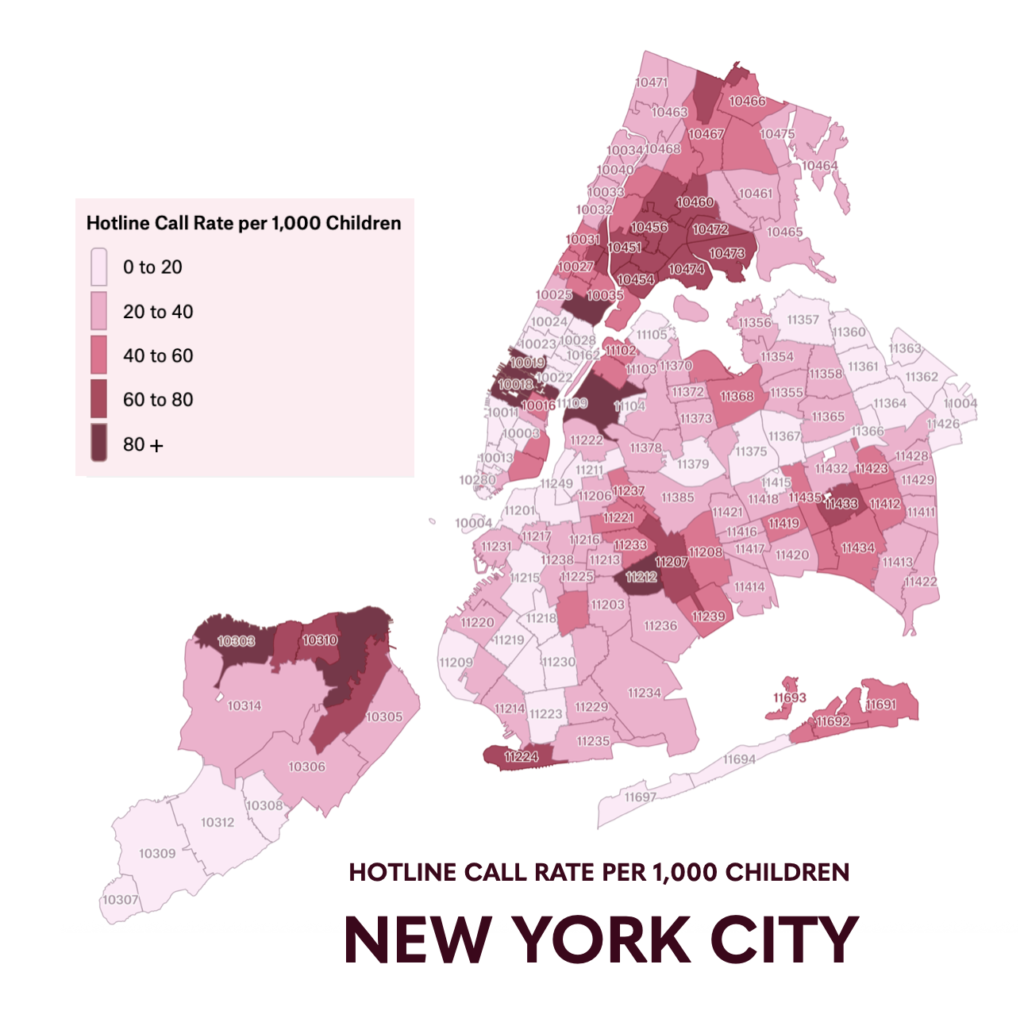
In NYC, child welfare involvement is hyperconcentrated in a small number of neighborhoods, and it has been for decades. A quarter of all ACS investigations of Black families, for instance, occur in just nine of the city’s hundreds of zip codes.
While poverty is a significant driver of child welfare involvement, and child poverty is high in these neighborhoods, decades of research shows that neighborhoods exert their own influence on family life, safety and well-being, including child welfare involvement.
Parents understand intuitively that raising children can be made easier, or harder, by the conditions that surround families. A playground down the block, a local library with ‘Mommy & Me’ classes, or a nearby grocery store with healthy food options — simple neighborhood amenities can make everyday life feel more supported.
And access to and quality of basic city amenities and services is not equal, as NYC parents have described:
“In our communities, schools, parks, sports and arts programs for children, mental health supports for families, affordable and safe housing, and crisis services are often inaccessible or low quality. Yet rather than transform community conditions, our city’s resources go to targeting individual families.” – Rise, Target Conditions, Not Families
Throughout this series, FPP will:
- Provide a review of the growing body of research on the role that neighborhood conditions play in family life and child welfare involvement;
- Feature interviews with experts on neighborhood factors like greenspace, community groups and the social fabric that impact family well-being and maltreatment;
- Explore how New York City can create a stronger family supportive infrastructure, including by directing place-based investment to highly impacted neighborhoods.
The goal is to help advocates, policymakers, journalists and elected officials understand the research and envision how place-based investments and policies might better protect against child welfare involvement.
Research Explainer: How Neighborhood Conditions Can Shape Family Life and Influence Child Welfare Involvement
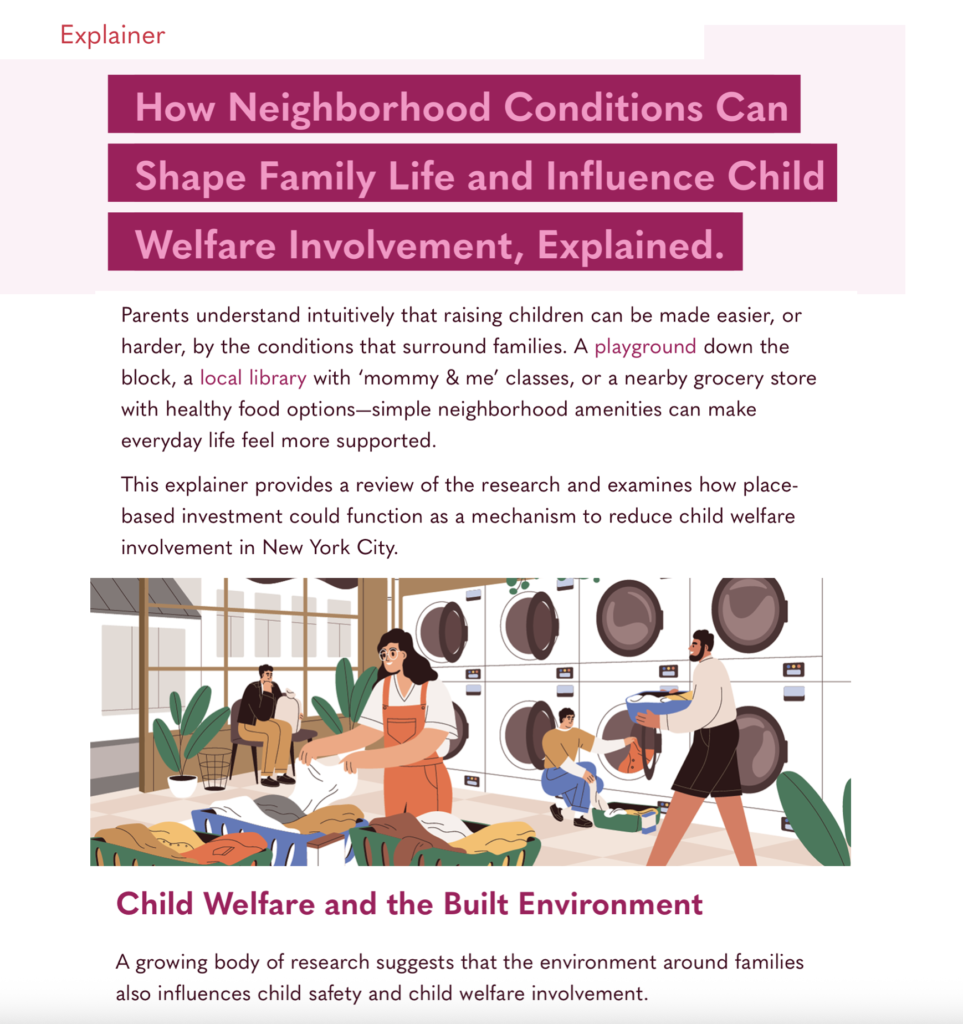
This Explainer provides a review of this growing body of research and examines how place-based planning, advocacy and investment could function to reduce child welfare involvement in New York City. Based on a review of 63 studies, and highlighting results of 31 articles, this Explainer shares the research evidence to date on the role of the built environment and the social fabric on child welfare.
Neighborhood Research Slide Set


This slide set highlights 23 studies on two major areas of neighborhood research: the built environment and the neighborhood social fabric.
Interviews with Researchers
- How the Neighborhood ‘Social Fabric’ Holds Together Family Life: Kristen Berg, Case Western Reserve University
- Greenspace and Child Welfare in Philadelphia: Yuan He, Children’s Hospital of Philadelphia
- Greenspace and Family Well-Being: Lauren Mullenbach, University of Michigan, and Rachel Thompson, CUNY Graduate School of Public Health and Health Policy
Place-Based Advocacy Efforts in NYC
- Calling for .5% of City Funding for the Libraries: Abby Emerson, Dylan Flesch and Mariame Kaba, NYC Public Library Action Network
- What Would a Family Well-Being Investment in Brownsville Look Like?
In recent years, advocates have introduced two interrelated proposals, a state Child and Family Well-Being Fund and a NYC Office of Family Well-Being, that would strengthen community investment in neighborhoods highly impacted by child welfare.
Both would:
- Support community-led planning and grantmaking to identify and build on neighborhood assets and fill gaps.
- Identify and create new, culturally responsive family programs that prevent and de-escalate family crises and promote family integrity, connection, resilience and safety.
- Prioritize investment and capacity-building support for grassroots organizations that families trust, with a focus on the neighborhoods most impacted by the child welfare system