
By Mahima Golani
For decades, a small number of NYC neighborhoods have borne the brunt of child welfare system involvement. Hotline calls, investigations and family separations are highly concentrated and segregated in NYC, where the 15 neighborhoods that drive involvement have remained largely the same for two decades.
While poverty is a significant driver of child welfare involvement, and child poverty is high in these neighborhoods, decades of research shows that neighborhoods exert their own influence on family life, safety and well-being.
Parents understand intuitively that raising children can be made easier, or harder, by the conditions that surround families. A playground down the block, a local library with ‘mommy & me’ classes, or a nearby grocery store with healthy food options—simple neighborhood amenities can make everyday life feel more supported.
Significant research shows that where a family lives influences a wide range of outcomes, including health and mental health, economic mobility, crime and child development. Even side-by-side communities with similar demographics can have very different family health and well-being profiles, including rates of child abuse and neglect, domestic violence, asthma and teen pregnancy. In short, neighborhood conditions shape family stress, safety, connection and access to resources in ways that can safeguard against or compound hardship.
A growing body of research has begun to examine whether neighborhood conditions have an independent effect on child welfare involvement, and advocates in New York have proposed place-based approaches to enhance family well-being and reduce child welfare involvement.
This explainer provides a review of the research and examines how place-based investment could function as a mechanism to reduce child welfare involvement in New York City.

The Wide-Reaching Impacts of Place
Neighborhood research got its start in Chicago. A portrait of two Chicago neighborhoods during a heat wave illustrates just how significant place can be in influencing health and well-being.
When a 1995 heat wave hit, two neighborhoods separated by just one street had vastly different outcomes: Auburn Gresham recorded three deaths per 100,000 residents; Englewood had 10 times as many. Both neighborhoods had high rates of poverty, unemployment and crime, but these communities felt different.
Over 30 years, half of Englewood’s residents had left, commercial spaces emptied and streets became quiet. To keep safe, residents began keeping to themselves and keeping inside. Auburn Gresham had a starkly different profile. Shopping corridors bloomed; barber shops, libraries and community organization doors were open. Residents were outside, going to book clubs and block association meetings, and neighbors had built up routines of checking in on one another. The neighborhood felt deeply connected.
During the heat wave, Auburn Gresham residents knocked on their neighbors’ doors, offering water and other ways to cool down. Researchers calculated the effect as the “rough equivalent of having a working air conditioner at home.”

Neighborhood Pathways to Health and Well-being
Neighborhood conditions determine what is easily available to families—or not—in daily life: access to quality schools and childcare, safe public spaces and services, reliable transit, social gathering spaces or collective action networks. From maternal and infant mortality rates to life expectancy, these conditions exert strong, wide-reaching effects that affect families over generations.
- Moving from a high- to low-poverty neighborhood in youth—and living in neighborhoods where rich and poor build relationships across class—have been associated with better adult economic outcomes, including higher college attendance and higher earnings.
- Children struggled more on tests and with behavioral issues days after a violent incident on their block, even when they did not witness it directly.
- Individuals with low social support in neighborhoods with high social isolation had a higher likelihood of developing depressive and anxiety disorders.
Social scientists have sought to uncover the pathways through which neighborhoods ‘get under the skin.’
Specific neighborhood factors—like greenspace, walkability, or food access—each influence health in a distinct way. Residents feel healthier and less lonely in neighborhoods with more accessible greenspace, for example, and obesity and related health problems are less common in places where it is safe and pleasant to walk, and where healthy food is readily available.
Another neighborhood factor is collective efficacy—the sense of place and belonging that encourages residents to act in solidarity. Research on violence reliably finds that neighborhoods that function as communities consistently have lower crime.
Taken together, differences in the physical and social environment function together to affect how safe families feel, how easily they can meet basic needs and where they can turn for support.

Child Welfare and the Built Environment
A growing body of research suggests that the environment around families also influences child safety and child welfare involvement.
One area of research has examined the physical environment of neighborhoods—walkability, playgrounds, libraries and other everyday amenities. While evidence of impact on child welfare is still emerging, the built environment has been shown to have significant effects on other domains of family life, such as children’s behavior and development and the formation of strong and supportive social networks. For instance, neighborhoods with more and better maintained greenspace, like trees, parks and other outdoor areas, typically impact families by reducing stress, improving mental health and enabling social connection.
On child welfare specifically, one study interviewed caregivers to understand how they thought a neighborhood’s built environment could be affecting child maltreatment. Parents described shared public places like parks, libraries and community centers as “relief valves” that give children outlets and allow caregivers to rest and connect with others. As one parent explained:
“Community centers, playgrounds, libraries…things that the children can do that are positive, so parents can kind of get that reprieve…maybe be at home prepping dinner or just having a moment to relax.”
Another parent discussed how built environment features can directly lead to social support:
“You meet other parents at the park…and then you can ask, ‘Well, do you have that same problem?’ And they can be like, ‘Yeah’. And [you could ask] ‘Well, how do you handle it?’”
Other research has explored whether places with more greenspace have lower child welfare involvement. While this research isn’t “causal”—meaning that it doesn’t prove whether access to greenspace causes a reduction in child welfare involvement—several studies found a relationship, even after controlling for other explanations, like differences in neighborhood poverty. Specifically:
- Increased density of neighborhood greenspace was associated with decreased risk of substantiated child maltreatment, cases accepted for services and foster care placement (He et al., 2024)
- Areas with the lowest tree canopy and green space had the highest reports of child abuse and neglect (Barboza-Salerno, Duhaney et al., 2025).
- “Greening” vacant properties at the zip code level was associated with fewer reports (-57%), after controlling for race, neighborhood disadvantage and crime (Sokol et al., 2022)
Another study found that, when mothers perceived their neighborhood environment more positively, they self-reported significantly lower physical maltreatment. The study authors suggest that this is because parents let children play outside more in neighborhoods they felt more positively about, and that outdoor play led to fewer child behavior problems that strain parents. In neighborhoods that parents consider unsafe, heightened vigilance, limited support and children being kept indoors may increase household strain.
NYC parents have described how access to and quality of basic city amenities and services are not equal
- “In our communities, schools, parks, sports and arts programs for children, mental health supports for families, affordable and safe housing, and crisis services are often inaccessible or low quality. Yet rather than transform community conditions, our city’s resources go to targeting individual families.” – Rise, Target Conditions, Not Families
- “If parks and libraries are not safe and welcoming, parents don’t have the opportunity to build relationships at story time or as their children run around. Small acts of community serve as a net for all families. Yet collective care networks thrive through a level of community stability that current public policy does not support.” – Rise, Target Conditions, Not Families
The Role of Neighborhood “Disorder”
Neighborhood “disorder” has long been studied, with significant research showing that when cities allow disorder like vacant lots, abandoned buildings and garbage, residents perceive the neighborhood to be less safe, which can increase parental stress and isolation. Visible neighborhood caretaking, on the other hand, can lead to positive neighborhood perceptions, which can foster resilience and more engaged parenting.
Child welfare scholars are beginning to examine whether disorder specifically impacts maltreatment and involvement, and find some connections, even when controlling for poverty. Specifically:
- High vacant property or abandoned building rates were associated with higher self-reported maltreatment and neglect (Fleckman et al., 2024).
- Greener, better lit and mixed-use areas in neighborhoods with moderate perceived safety corresponded to fewer neglect reports, after adjusting for neighborhood disadvantage (Barboza-Salerno, Harrington et al., 2025).
- Less physical disorder (graffiti, abandoned cars, broken windows, and garbage in the streets) and social disorder (street harassment, public intoxication) was associated with lower rates of indicated reports at the neighborhood level (Molnar et al., 2016).
Access to Basic Amenities and Services
For parents with limited time, accessibility is paramount. However, a cluster of studies on access to resources and services, like grocery stores or drug treatment programs, or negative neighborhood outlets, like liquor stores, have found mixed results.
On child welfare, significant research has documented that material hardships, like food insecurity, reliably predicted involvement. This extends to neighborhood accessibility, with the accessibility of stores that accept SNAP associated with fewer hotline calls (-4.4%) and fewer substantiated investigations (-11.3%) (Bullinger, 2021).
Similarly, some studies find that closer access to substance use and mental health services was associated with fewer reports and self-reported maltreatment (Morton et al., 2014; Maguire-Jack & Klein, 2015). However, others have found that closer proximity to services (or even service enrollment) actually increased the likelihood of child welfare involvement, and still others found no associations (Maguire-Jack & Klein, 2015; Maguire-Jack & Negash, 2016). Study authors note the role of exposure to mandated reporters, and barriers such as insurance coverage may limit service access.
Several studies also find that higher numbers of neighborhood bars and liquor stores were associated with higher rates of physical maltreatment, reporting and foster care entries, although others found mixed or opposite patterns (Freisthler et al., 2007; 2014; Morton et al., 2014, Freisthler & Holmes, 2012).
How NYC advocates have envisioned that neighborhood built environments can better support family life and reduce child welfare involvement
- “Sometimes, healing means being connected to green spaces, having space to talk to other people, or being able to go to the gym.” – The New Hood, Community Healing Policy Agenda
- “[Fund] holistic community centers that provide after-school programs, camps, community services, peer mentoring and more in a single accessible place.” – Rise, An Unavoidable System
- "Support local and trusted community organizations that have historically provided families with a safety net including, but not limited to, churches, mutual-aid groups, doulas, food pantries, and recreational and after-school centers.” – Narrowing the Front Door to NYC’s Child Welfare System
- “[Create] free community-run centers where young people in the neighborhood can do free activities together.” – Black Families Love and Unite, Families Belong Together, Families Demand Repair

Child Welfare and the Neighborhood Social Fabric
In addition to the built environment, much neighborhood research has focused on the social fabric—the relationships between people and between informal groups and associations, neighborhood organizations and institutions, that knit a community together.
One key concept is “collective efficacy,” which describes a sense of place and belonging that can enhance shared responsibility for what happens in the neighborhood and prompt action to address concerns. In a major study on Chicago neighborhoods, Robert Sampson and colleagues interviewed 9,000 residents in 300 neighborhoods, videotaping the physical conditions of 22,000 blocks. Their work provided a way to understand how everyday interactions and relationships shape communities where neighbors are likely (or unlikely) to undertake shared efforts towards collective goals, such as reducing violence, engaging with and caring for young people, or responding to threats.
Sampson’s study found that neighborhoods with similar poverty and disadvantage could have major differences in crime rates and other factors, like the health effects documented in Heat Wave, because of neighborly care, intervention and civic action. More recent research has documented that the presence of grassroots community groups focused on neighborhood life, youth development and crime significantly contributes to these reductions in crime, including in NYC.
While active neighborhood care isn’t easy to capture in social science measures, neighborhoods with strong identities where people take action together usually have robust social networks (“social cohesion”) and are able to enforce positive norms and address threats to the neighborhood (“informal social control”). Researchers assess collective efficacy by asking questions like, “Could your neighbors be counted on to intervene if children were skipping school and hanging out on a street corner?” or “Are people in your neighborhood willing to help their neighbors?” (In NYC, these questions are captured in neighborhood health surveys.)
A study that used 1995-2005 data from the Chicago research examined the impact of collective efficacy and other social processes on child welfare involvement. They found that neighborhoods with a stronger social fabric had lower substantiated cases of neglect, physical abuse and sexual abuse, after taking into account factors like poverty and some crime, with collective efficacy having the biggest effect. Stronger collective efficacy and social networks also predicted lower rates of substance-exposed infants.
Likewise, several studies found that higher perceived collective efficacy was associated with lower maltreatment (Wang & Frost, 2025; Kim & Maguire-Jack, 2015; Freisthler & Maguire-Jack, 2015; Maguire-Jack & Font, 2017), although others found no direct relationship (Barnhart & Maguire-Jack, 2016; Molnar et al., 2003). Neighborhood collective efficacy also impacts a wide range of issues that affect family life, including those that have direct impacts on child maltreatment and child welfare involvement, such as domestic violence and substance abuse.
What are “social processes”?
- Collective efficacy describes a sense of place and belonging that can enhance shared responsibility for what happens in the neighborhood and prompt action to address concerns. Neighborhoods with high collective efficacy consistently have lower crime, stronger local engagement and greater resilience during crises.
- Social cohesion and support refer to how well neighbors know and can rely on one another for information, care, or practical assistance. Higher perceived neighborhood support has been associated with lower parental stress, reduced isolation and better mental health.
- Informal social control describes neighbors’ willingness to take action to address shared concerns––like watching out for children in public spaces, or responding to potential safety issues––which has been found to contribute to a greater sense of safety and lower stress.
- Social capital refers to the resources that are embedded in social relationships and local institutions, like access to information through community leaders, or mutual aid organizations that support with access to basic needs or collective problem solving. High neighborhood social capital has been related to better individual and community-level health outcomes and higher use of resources and services.
The Protection of Social Connectedness
Across two large research reviews of over 60 studies on social processes and child maltreatment, it is clear that the neighborhood social environment affects family well-being, child maltreatment and child welfare involvement. These reviews found that social cohesion and support were reliably protective against maltreatment.
Several child welfare studies show that stronger social networks and higher participation in community life are linked with lower child welfare involvement:
- Participation in neighborhood institutions (such as churches or community-based organizations) was associated with lower self-reported maltreatment (Cao & Maguire-Jack, 2016).
- Lower neighborhood social cohesion and trust was linked to higher odds of self-reported child welfare contact (Ma et al., 2018).
- Higher neighborhood poverty was linked to more substantiated maltreatment because of weaker social cohesion in these neighborhoods (McLeigh et al., 2018).
- Neighborhoods where parents know the parents of their children’s friends (called “intergenerational closure”), and generally strong social ties, show lower maltreatment rates (Molnar et al, 2016).
A small cluster of studies has tried to understand the role of social capital in supporting child well-being and reducing child welfare involvement (Jespersen et al., 2021; Nawa et al., 2018). One recent study found that social capital and nonprofit density are related to reduced child maltreatment rates (Mayer, 2022). They suggested that, similar to findings on crime, the number of nonprofits increased service access and their presence facilitated stronger social relationships, fostering activism and motivating residents to improve their communities.
Research shows that individual parents draw back social networks and help-seeking after an investigation, which can increase isolation and limit potential support. However, research has not examined how these individual adjustments might impact the entire neighborhood fabric, particularly in neighborhoods where investigations are prevalent.
How NYC advocates have documented the role of social relationships and community groups in buffering against child welfare involvement
- “Having a strong community support network is overwhelmingly important. If I had just the parent advocacy portion of my network when ACS knocked on my door, oh my God, that case would have been closed in a week.”- Rise, An Unavoidable System
- “I think it’s important to have a network, because through that network you get assistance, collect information and you feel supported and loved.” – Rise, An Unavoidable System
- “Policymakers and even many community members may not be directly aware of how community groups de-escalate potential crises and support safety.” – Rise, Someone to Turn To

Moving from Research to Targeted, Place-Based Policymaking
Growing exploration and evidence of the impacts of neighborhood conditions on child maltreatment and child welfare involvement can help advance effective place-based strategies to support families.
Evidence of how neighborhoods impact health and violence has led researchers, policymakers and community groups to implement and test interventions at the community level to address a variety of public health issues and enhance family life.
On crime, for instance, two randomized control trials—the gold standard in research—found that cleaning and greening interventions, including trash clean up and tree and grass planting, caused large reductions in gun violence and improved mental health outcomes in Philadelphia. Researchers found that participants’ perception of crime was lower, and that residents were more likely to use outside spaces, which increased social interactions and discouraged negative behavior, as there were more “eyes on the street.”
Similarly, the Cure Violence approach, broadly implemented in NYC through local groups like Brownsville In Violence Out (BIVO), also rests on neighborhood research. While interrupting conflicts and working with individual young people and their families through a public health approach, community groups also bring together neighborhood residents to address neighborhood-level drivers of violence.
On chronic illness, decades of evidence has shown the health impacts of limited access to healthy food, accessible transit and greenspace, which disproportionately impact Black and low-income families. That evidence has led cities, including NYC, to invest in understanding and addressing inequitable neighborhood conditions that drive chronic illness. In 2018, NYC launched an incentive program to attract grocery stores to food deserts. More recently, the city has promoted the development of urban farms and locally grown food, including local food justice organizations.
Likewise, the city’s planning department promotes design guidelines for integrating physical activity into outdoor spaces and strives for walkable parks in every community, with an optimal ratio of 2.5 acres of open space per 1,000 residents. The Brownsville Plan, for instance, resulted in park renovations and more street lighting, and the Hunts Point plan has created waterfront parks, bike paths and bus routes.

Applying Place-Based Solutions to Child Welfare
Place-based strategies to address child maltreatment and child welfare involvement have been undertaken since the 1990s, when the U.S. Advisory Board on Child Abuse and Neglect issued a series of reports recognizing the role of community conditions in child welfare involvement. However, these efforts have been limited and some have focused more on educating and assessing families—or creating new supports tethered to child welfare agencies—than on investing in existing community groups and networks and enhancing neighborhood conditions.
One promising approach in South Carolina sought to increase collective efficacy to prevent child maltreatment by deeply engaging residents and community groups. Over two years, outreach workers organized communities to “keep kids safe” by watching out for one another through campaigning with volunteers and local groups. Over 3,000 families were enrolled and thousands more participated in activities like parents’ nights out, play groups or extra well-care visits for family support.
While the approach was slow to show impact, a 2015 assessment found that the program reduced child injuries and substantiated maltreatment. Surveys showed that randomly sampled residents felt a change in the neighborhood, even when they were not directly involved in the program. Their neighborhoods felt more cohesive, and they felt that their neighbors were more willing to pull together. They also found small but significant improvements in neighborly support and help giving and parenting practices. This study offers some evidence that child welfare involvement can be reduced by strengthening the social fabric, which enhances access to basic needs and social support networks.
NYC Visions for Community Investment
Advocates in New York have documented the role of neighborhood conditions in family stress and separation. Reports such as Rise’s Unavoidable System and From the Ground Up and recommendations from YouthNPower, Black Families Love and Unite and the Narrowing the Front Door Work Group include calls for community-based supports and investments.
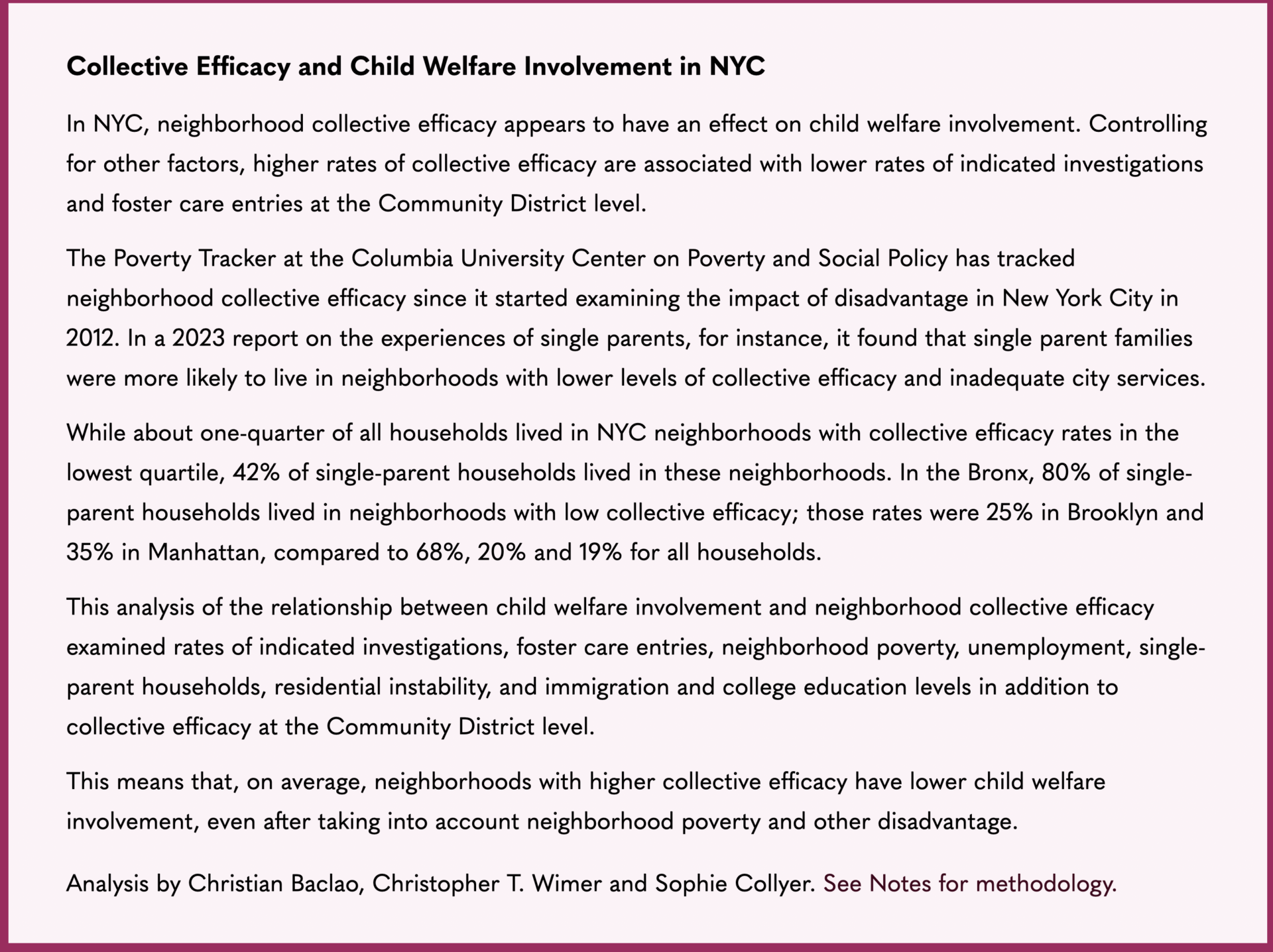
Research on the link between neighborhood conditions and child welfare involvement has not been done in NYC. However, some data and research suggest that place-based strategies could meaningfully complement investments in the economic stability of families. Child welfare involvement is concentrated in neighborhoods impacted by historical deprivation. While gentrification has reshaped much of NYC, the six Bronx neighborhoods with the highest percentage of residential land classified as “hazardous” under redlining are those with the highest number of investigations and removals today. Likewise, single parents—who are more likely to become child welfare involved—are also more likely to live in neighborhoods with low collective efficacy and less likely to be able to call on support networks during a crisis.
Further, about 70% of all social services spending flows through large organizations that are highly identified with the child welfare system, not community groups that are more likely to be led by people of color and grounded in the neighborhoods where they are located.
Two interrelated proposals—for a state Child and Family Well-being Fund and a NYC Office of Family Well-being—would target community investment to neighborhoods highly impacted by child welfare.
Consistent with research on collective efficacy, these visions seek to strengthen the neighborhood social fabric that protects and supports families. They also call for community grantmaking to invest in these trusted organizations with a track record of supporting families. As research shows, grassroots community groups are often central sources of support, restorative care and healing, and can act as primary responders to families in need, as they do in initiatives that have brought down crime.
Developed by parents and young people impacted by the child welfare system, these proposals match and build on decades of research on neighborhood effects on family health, life and safety. Neighborhood-based strategies can offer another tool to support families and combat family stress and separation.